LoRa Modulation
Contents
Part 1 — Introduction
When designing a wireless sensor network, one of the first challenges we encounter is communication.
In many cases, the requirements are quite different from traditional wireless systems. We are not trying to stream video or transfer large amounts of data. Instead, we typically need to transmit only a few bytes — but over long distances, and often from battery-powered devices that must operate for months or even years.
At the same time, the environment is rarely ideal. Sensors may be deployed in industrial installations, agricultural fields, or remote locations, where obstacles, interference, and noise are part of the problem.
This leads to a very specific question:
How can we achieve reliable communication over long distances, while keeping power consumption extremely low?
This is precisely the problem that Low-Power Wide-Area Network (LPWAN) technologies aim to solve.
Among these technologies, LoRa has become one of the most widely used solutions. It operates in unlicensed frequency bands, is relatively simple to deploy, and can achieve communication ranges of several kilometers while maintaining very low energy consumption.
For example, a sensor may transmit a few bytes every 10 minutes from a remote location, and still operate for years on a single battery.
Over the past decade, the adoption of LoRa has grown rapidly. Today, the number of deployed LoRa-enabled devices is on the order of several hundred million worldwide, with networks covering a large number of countries and application domains.
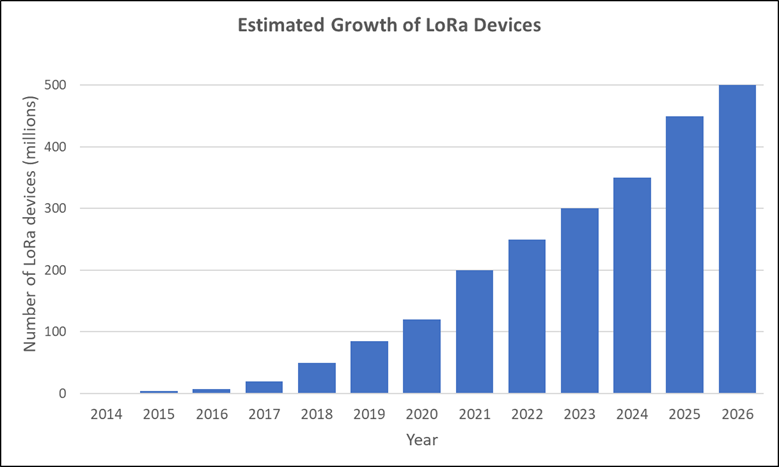
Figure 1 — Estimated growth of LoRa devices worldwide.
The number of deployed devices has increased rapidly over the past decade, reaching several hundred million.
This rapid adoption is not accidental. It reflects the fact that LoRa addresses a very specific niche in wireless communication — one where range, power consumption, and simplicity are often more important than raw data rate.
However, what makes LoRa particularly interesting is not only its range or energy efficiency, but the way it achieves these properties.
Unlike conventional wireless systems, LoRa does not rely on narrowband transmission. Instead, it uses a modulation technique based on frequency-swept signals, known as Chirp Spread Spectrum.
At first glance, this approach may seem unusual. Rather than transmitting information using fixed-frequency tones, LoRa encodes data using signals whose frequency continuously changes over time. As we will see, this has important consequences in terms of robustness, sensitivity, and overall system performance.
In this tutorial, we will build a clear understanding of how LoRa modulation works, starting from the context of wireless sensor networks and progressively moving toward the underlying physical principles.
We will first place LoRa within the broader landscape of wireless communication technologies used in sensor networks. Then, we will introduce the concept of chirp signals and see how they are used to encode information. Finally, we will examine the key parameters of LoRa modulation and understand how they influence range, data rate, and energy consumption.