LoRa Modulation
Contents
- Introduction
- Wireless Sensor Networks and LPWAN
- LoRa Basics
- LoRa Parameters
- Summary and Outlook
Part 2 — Wireless Sensor Networks and LPWAN
Before going deeper into LoRa itself, it is useful to clarify the context in which it is used.
WSN and IoT: two perspectives on the same systems
Two terms are often encountered in this domain: Wireless Sensor Networks (WSN) and Internet of Things (IoT). They are sometimes used interchangeably, although they originate from slightly different perspectives.
A Wireless Sensor Network typically refers to a system composed of distributed sensor nodes that collect data and communicate it to a central point, often through one or more gateways. The focus is primarily on sensing, communication, and energy efficiency.
The term Internet of Things, on the other hand, emphasizes connectivity at a larger scale. The word “Internet” itself comes from inter-network, meaning a network that connects multiple smaller networks together. In this sense, IoT systems are not just collections of devices, but systems in which these devices are integrated into a broader network infrastructure.
This is where the notion of a gateway becomes important.
The role of the gateway
A gateway connects two networks, often using different communication technologies. It acts as an interface between two networks, potentially using different communication technologies.
A simple analogy is a home modem or router, which connects a local network to the internet. In a similar way, in a wireless sensor network, a gateway connects a network of sensor nodes to a wider IP-based network.
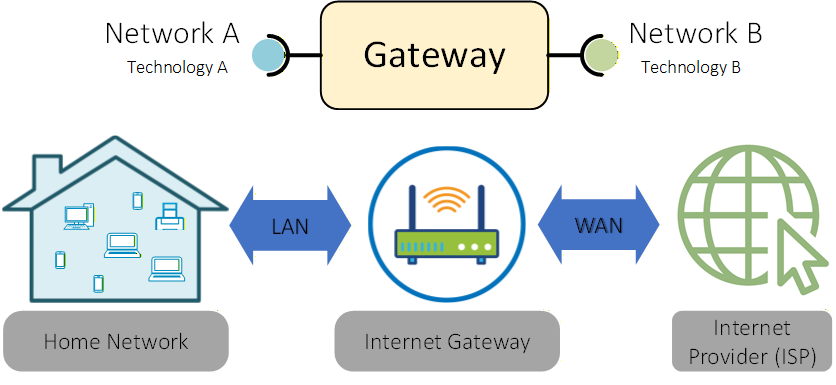
Figure 1 — A gateway connects two networks.
A gateway acts as an interface between two networks, potentially using different communication technologies, in the same way that a router connects a local network (LAN) to a wider network (WAN / Internet), acting as a gateway.
From WSN to IoT systems
In practice, the distinction between WSN and IoT has become less important.
Most modern IoT systems rely on networks of distributed sensors, which are, by definition, Wireless Sensor Networks. Conversely, most WSN deployments today are connected to the internet, making them part of IoT systems.
We can therefore think of WSN and IoT not as separate domains, but as two complementary perspectives on the same systems:
- WSN emphasizes how data is acquired and transported
- IoT emphasizes how data is integrated, processed, and used
A typical system can be represented as follows:

Figure 2 — Typical WSN / IoT architecture.
Sensor nodes communicate with a gateway, which connects them to a wider network and ultimately to applications.
At this level, the communication between the sensor nodes and the gateway is often the most constrained part of the system.
Communication constraints
Sensor nodes are typically:
- battery powered
- deployed in large numbers
- expected to operate for long periods without maintenance
The data being transmitted is usually small — often just a few bytes — and does not require high throughput. However, the communication range can be significant, especially in outdoor or industrial environments.
This combination of constraints makes many conventional wireless technologies unsuitable.
For example:
- WiFi provides high data rates, but consumes too much power
- BLE offers low power consumption, but limited range
- Zigbee improves scalability, but still operates over relatively short distances
What is needed is a different class of communication technologies, designed specifically for:
- long range
- low data rate
- low power consumption
This is the domain of Low-Power Wide-Area Networks (LPWAN).
Positioning of wireless technologies
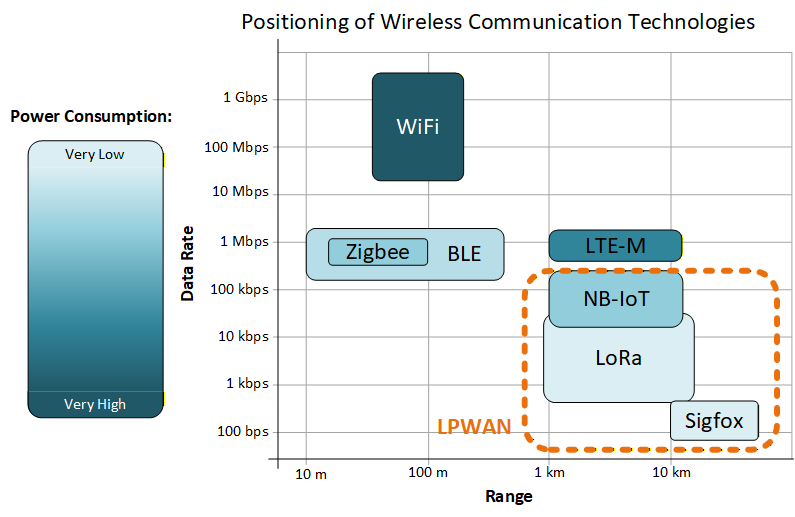
Figure 2 — Positioning of wireless communication technologies.
Short-range technologies such as BLE, Zigbee, and WiFi provide higher data rates over limited distances, while LPWAN technologies such as LoRa, Sigfox, NB-IoT, and LTE-M prioritize long range and low power consumption at the expense of data rate. Within the LPWAN family, several technologies exist.
Some, such as NB-IoT and LTE-M, rely on cellular infrastructure and operate in licensed frequency bands. Others, such as Sigfox and LoRa, operate in unlicensed spectrum and can be deployed more flexibly.
LoRa distinguishes itself by combining:
- relatively simple deployment
- good sensitivity
- flexible configuration parameters
These properties make it particularly well suited for a wide range of sensor network applications.